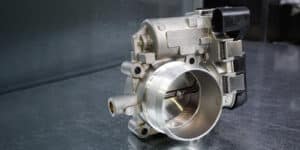


Think of your car’s engine as a master chef, meticulously preparing the perfect air-fuel mixture for combustion. But even the best chef needs a trusted taste-tester. In your engine, that role is played by the Oxygen Sensor, also known as the O2 Sensor or Lambda Sensor. For over 30 years, this small but mighty component has been the silent guardian of your engine’s efficiency and the environment’s well-being. Let’s dive deep into how it works, why it fails, and how to keep it in top shape.
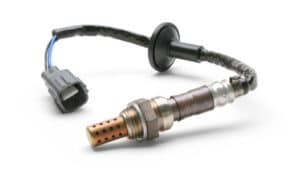
What Exactly is an Oxygen Sensor?
In simple terms, an Oxygen Sensor is your car’s primary feedback device for fuel management. It’s mounted in the exhaust stream, where its job is to measure the amount of unburned oxygen in the exhaust gases. This critical data is sent to the engine’s computer (the ECU), which uses it to adjust the air-fuel ratio in real-time, aiming for the perfect “stoichiometric” mix—approximately 14.7 parts air to 1 part fuel. This perfect balance ensures optimal combustion, maximum power, and minimal harmful emissions.
The Two Key Locations of Your O2 Sensors
Modern cars are equipped with at least two oxygen sensors, each with a distinct role. Understanding their placement is key to diagnosing issues.
- Upstream Sensor (Sensor 1): This sensor is located before the catalytic converter, often in the exhaust manifold or downpipe. Its primary job is to monitor the air-fuel mixture coming directly from the engine. The ECU uses this data for constant fuel trim adjustments.
- Downstream Sensor (Sensor 2): Positioned after the catalytic converter, this sensor’s main role is to monitor the converter’s efficiency. It checks how well the “cat” is cleaning the exhaust gases. If the readings from the upstream and downstream sensors are too similar, the ECU knows the catalytic converter has failed.
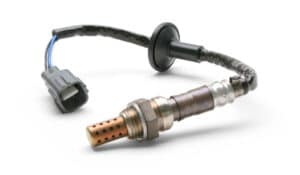
Decoding the Symptoms of a Failing O2 Sensor
A faulty oxygen sensor can’t do its job, and your car will quickly start telling you something is wrong. Don’t ignore these common warning signs:
- A Dramatic Drop in Fuel Economy: This is the most common symptom. A bad sensor can cause the ECU to default to a rich mixture, wasting fuel.
- The Check Engine Light Glows: The ECU is constantly monitoring the sensor’s signal. Any irregularity will trigger a diagnostic trouble code (DTC) and illuminate the light.
- Rough Engine Idle and Stalling: Incorrect air-fuel mixtures can lead to a shaky, unstable idle, and in some cases, cause the engine to stall.
- Failed Emissions Test: Since the sensor directly controls emissions, a faulty one will almost certainly cause your car to fail a smog check.
- Poor Engine Performance: You might notice engine hesitation, misfires, or a general lack of power during acceleration.
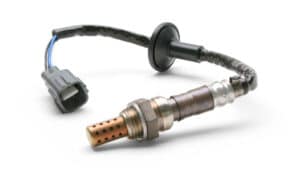
How to Diagnose a Bad Lambda Sensor
While a proper diagnosis often requires a professional scan tool, there are checks you can be aware of. A mechanic will typically:
- Read the stored diagnostic trouble codes (e.g., P0130 – O2 Sensor Circuit Malfunction).
- Use a scan tool to observe the sensor’s voltage output in real-time data. A healthy sensor will fluctuate rapidly between 0.1 and 0.9 volts. A lazy or flat signal indicates a problem.
- Check the sensor’s heater circuit, as most modern sensors have an internal heater for fast operation.
A Guide to Oxygen Sensor Voltage Signals
The voltage signal from the O2 sensor is its language. Understanding this language is crucial for diagnosis. Here’s a simple breakdown of what the voltage means.
| Voltage Signal | Air-Fuel Mixture Interpretation | ECU Action |
|---|---|---|
| High (0.5V – 0.9V) | Rich Mixture (Too little oxygen, too much fuel) | The ECU will reduce the fuel injector pulse width to lean out the mixture. |
| Low (0.1V – 0.5V) | Lean Mixture (Too much oxygen, too little fuel) | The ECU will increase the fuel injector pulse width to enrich the mixture. |
| Constantly Switching (0.1V – 0.9V) | Ideal Operation. The sensor is active and the fuel control loop is “closed.” | The ECU is constantly making fine adjustments for perfect combustion. |
Frequently Asked Questions About O2 Sensors
What happens when an oxyqen sensor goes bad?
When an oxygen sensor fails, it sends incorrect or no data to the car’s computer. This disrupts the precise control of the air-fuel mixture, leading to poor fuel economy, rough idling, increased emissions, and potential damage to the catalytic converter over time.
What is the normal output of a functioning oxygen sensor?
A fully functional O2 sensor produces a constantly fluctuating voltage signal, typically ranging from about 0.1 volts (indicating a lean mixture) to 0.9 volts (indicating a rich mixture). This rapid switching is a sign of a healthy sensor and a properly functioning fuel control system
Can a faulty O2 sensor cause the engine to shake or misfire?
Yes, absolutely. If the sensor is providing a false “lean” signal, the ECU will dump in excess fuel, causing a rich condition that can foul spark plugs and lead to misfires and a shaking sensation. Conversely, a false “rich” signal can cause a lean condition, which also results in rough running and hesitation.
How often should oxygen sensors be replaced?
There’s no set mileage, but as a rule of thumb, many mechanics recommend inspecting and considering replacement around 60,000 to 90,000 miles for newer heated sensors. Older models may need replacement sooner. Refer to your vehicle’s service manual for specific recommendations.
Is it safe to drive with a bad oxygen sensor?
While you can typically drive the car for a short time, it is not advisable. You will be burning more fuel, harming the environment, and risking costly damage to your catalytic converter. Address the issue as soon as possible.
Are the Mass Air Flow (MAF) Sensor and Oxygen Sensor related?
Yes, they are key partners in engine management. The Mass Air Flow (MAF) Sensor measures the amount of air entering the engine, which the ECU uses to calculate the base fuel injection pulse. The Oxygen Sensor then provides feedback on how well that calculation worked, allowing the ECU to make fine corrections. A faulty MAF can often “trick” you into thinking the O2 sensor is bad.
What other sensors work closely with the O2 sensor?
Besides the MAF sensor, the Manifold Absolute Pressure (MAP) Sensor is another critical component. On many turbocharged or specific engine designs, the MAP sensor measures engine load, which is vital information the ECU uses alongside the O2 sensor data to determine the optimal fuel and ignition timing.
For a more detailed historical and technical perspective, you can refer to the general page on oxygen sensors on Wikipedia.
Remember, a healthy oxygen sensor is a key ingredient for a efficient, powerful, and clean-running engine. Paying attention to its subtle warnings can save you time, money, and a lot of frustration down the road.